
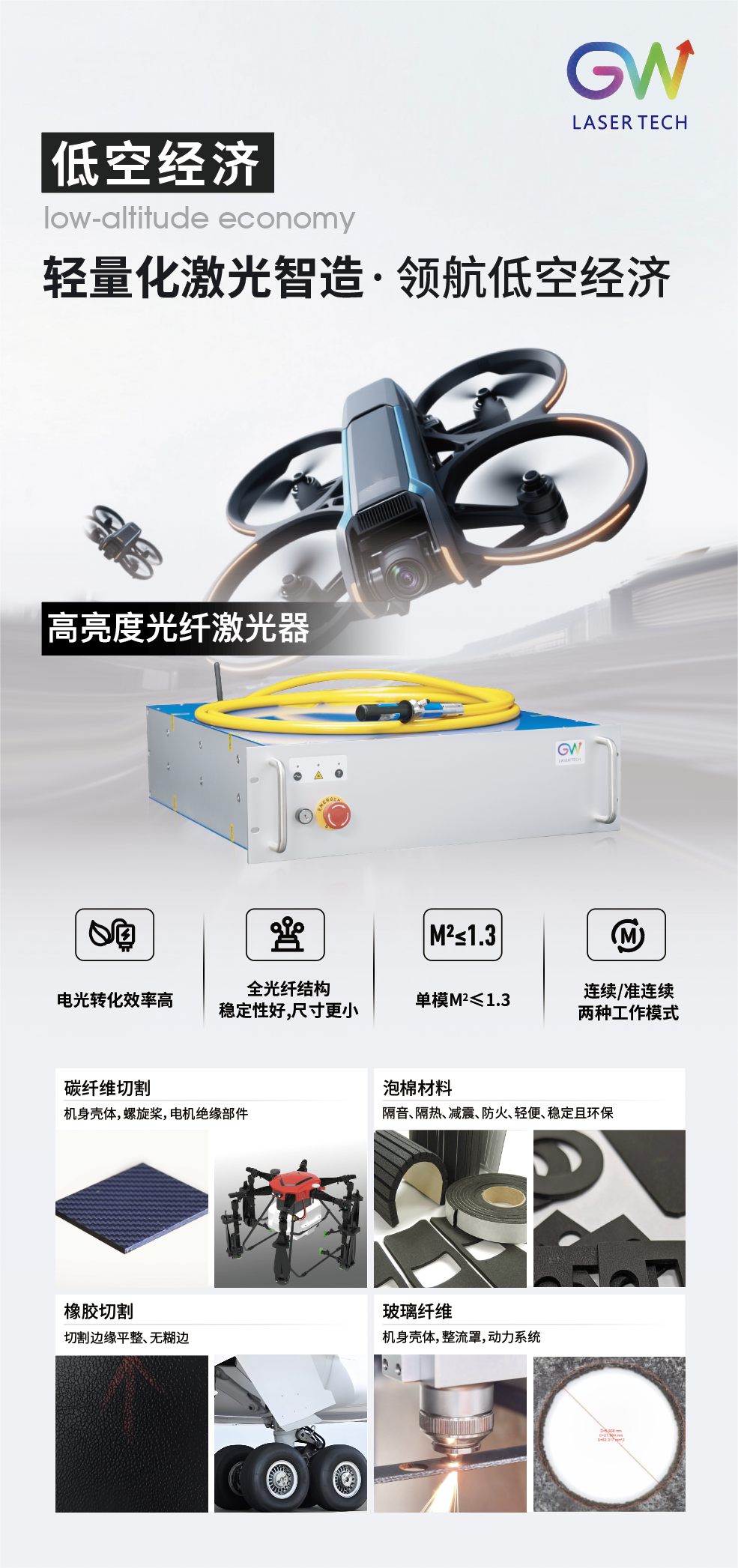
With the rapid development of the low altitude economy worldwide, the demand for lightweight and high-strength composite materials in aircraft such as drones and eVTOLs (electric vertical takeoff and landing vehicles) is increasing. Carbon fiber, glass fiber, PPS (polyphenylene sulfide), foam, rubber and other materials have become the core materials for low altitude aircraft manufacturing due to their excellent strength to weight ratio and corrosion resistance. However, while these materials enhance the performance of aircraft, their precision machining has always been a common challenge faced by the industry. Guanghui Laser has provided a breakthrough solution for composite material cutting in the low altitude economic field through technological innovation in high brightness fiber lasers.
01Characteristics, application scenarios, and processing challenges of low altitude economic composite materials
Low altitude aircraft require extremely high precision, weight, and reliability of their components, and traditional manufacturing methods are often difficult to meet their stringent standards.
○ Carbon fiber composite material ○
[Features and Advantages]
·The specific strength is up to 5 times that of steel, and the density is only 1/4 of steel
·Corrosion resistant and fatigue resistant, suitable for long-term harsh environments
·More than 30% weight reduction can be achieved in the eVTOL body structure
【 Application Scenarios 】
·Main load-bearing structural components of unmanned aerial vehicles
·EVTOL cabin framework
·Aircraft wing skin
[Difficulties in Processing]
·Mechanical processing can easily lead to fiber delamination, burrs, and rapid tool wear (domestic tools have a lifespan of only 2-3 hours)
·Traditional laser cutting has severe carbonization, with a heat affected zone greater than 200 μ m, reducing material fatigue strength
·Dust pollution poses a threat to aircraft electronic equipment
○ Glass fiber composite material ○
[Features and Advantages]
·Excellent insulation performance, suitable for electronic equipment compartments
·The cost is only one-third of carbon fiber, suitable for large-scale applications
·Strong weather resistance, suitable for long-term outdoor use
【 Application Scenarios 】
·UAV electronic equipment casing
·Ground station radar cover
·Aircraft fairing
[Difficulties in Processing]
·The milling machine generates glass dust, which poses a health hazard to the operators
·Water jet cutting accuracy is low (± 1mm), and the cost of wastewater treatment is high
·CO ₂ laser cutting edge turns yellow, affecting product aesthetics
○ Polyphenylene sulfide PPS ○
[Features and Advantages]
·Long term use temperature can reach over 200 ℃
·Excellent flame retardant performance (UL94 V-0 grade)
·Chemical corrosion resistance, suitable for fuel system components
【 Application Scenarios 】
·Thermal insulation components for drone battery compartment
·Engine peripheral components
·Electrical connector bracket
[Difficulties in Processing]
·Secondary processing after injection molding is prone to stress cracking
·Traditional hot knife cutting leads to edge melting and deformation
·UV laser cannot process materials with a thickness greater than 1mm
○ Foam and rubber sealing materials ○
[Features and Advantages]
·Excellent damping performance and significant shock absorption effect
·Reliable sealing performance, suitable for waterproof and dustproof cabin
·Lightweight and does not affect the payload of the aircraft
【 Application Scenarios 】
·EVTOL cabin sound insulation seal
·Landing gear shock pad
·Sensor protective cover
[Difficulties in Processing]
·Traditional blade cutting has burrs and burnt edges
·Residual water stains after waterjet processing affect adhesive performance
·Difficulty in processing complex three-dimensional shapes
These pain points directly constrain the production efficiency and performance optimization of low altitude aircraft.
02Technological breakthrough of Guanghui high brightness fiber laser
Guanghui Laser has launched a laser processing solution specifically designed for composite materials, relying on its independently developed and produced "high brightness fiber laser". Through multiple innovations, it has overcome industry challenges
Ultimate beam quality (M ² ≤ 1.3)The focused spot diameter reaches the level of 30 μ m, achieving a cutting accuracy of ± 10 μ m and a smooth and burr free incision.
Intelligent temperature control technologyAccurate control of heat input ensures almost no carbonization (heat affected zone<30 μ m) during cutting of materials such as carbon fiber and PPS.
ABR anti high reflection technologyEffectively handle high reflective materials such as glass fiber and carbon fiber to avoid process instability caused by energy reflection.
Full fiber structure designThe device has a compact size and high stability, supporting both continuous and quasi continuous modes to meet the processing needs of multiple scenarios.
Drone body shell
processing effectCarbon fiber/PPS material can achieve non layered cutting, and the accuracy of propeller hole position can reach micrometer level.
Taking carbon fiber composite materials as an example, as an advantageous material in the manufacturing of unmanned aerial vehicle main load-bearing structural components and eVTOL cabin frames, especially when processing fuselage skin with a thickness of only 0.8mm, how to ensure the quality of the cut has become a common problem in the industry. In response to this pain point, the high brightness fiber laser developed by Guanghui Laser has demonstrated unique advantages. When combined with robots, it can achieve precise cutting of curved parts, and the installation hole accuracy reaches ± 0.02mm, fully meeting the requirements of aviation grade assembly.
Sound insulation and shock absorption components
processing effectFoam and rubber cutting edges have no burnt edges, maintaining sound insulation and fire resistance.
The multi-layer composite foam material used in eVTOL cabins often has a thickness of up to 30mm. The unique pulse technology of Guanghui Laser creates a "micro explosion" effect by controlling laser parameters, ensuring cutting accuracy while avoiding material damage. This process produces components with neat edges and no interlayer penetration, effectively ensuring the sound insulation performance of the aircraft.
Power system components
processing effectGlass fiber fairing cutting is dust-free, avoiding damage to electronic devices.
Taking the motor bracket made of glass fiber reinforced composite material as an example, it not only requires extremely high dimensional stability, but also strict weight control. The high brightness fiber laser of Guanghui Laser achieves micro level precision 3D machining through non-contact processing and visual positioning system. In practical applications, this technology enables the flatness of the bracket to reach 0.05mm/m2 and the weight deviation to be controlled within ± 3g, providing reliable guarantee for the efficient operation of the power system.
Landing gear seals
processing effectThree dimensional cutting of spring rubber sleeve without burrs improves sealing reliability.
Based on the elastic properties of special rubber materials, the laser technology of Guanghui Laser can accurately control the pulse width to ensure that no heat diffusion occurs before the material vaporizes. The lip size accuracy of the sealing component processed by this process reaches ± 0.01mm, with a surface roughness Ra ≤ 0.8 μ m, fully meeting the stringent requirements of aviation sealing.
03Technical endorsement: full industry chain support
Guanghui Laser relies on its Shanghai R&D center, Nantong module base, and Wuhan device base to build a vertically integrated industrial chain from chips, devices to modules. Its high brightness fiber laser has passed CE and FDA certification, and has been installed in over 20000 units in more than 100 countries worldwide. The R&D team led by founder Dr. Ding Jianwu has been deeply involved in 976nm technology for nearly 20 years, providing continuous driving force for product innovation.
Conclusion
The outbreak of low altitude economy has put forward higher requirements for composite material processing. Guanghui Laser, with high brightness fiber lasers as its core, solves industry pain points through technological breakthroughs and provides high-precision and low-cost processing solutions for industries such as drones and eVTOL. In the future, we will continue to deepen cooperation with global integrators and traders to jointly promote the upgrading of low altitude manufacturing technology.
- Follow us

 0
0