
Closed loop laser welding is changing the way high cycle, safety critical production lines control welding quality. The traditional approach is to first set fixed parameters and then perform post inspection on the finished product, while the closed-loop system observes the molten pool status in real time while welding and corrects the laser output in real time. For application scenarios such as power battery assembly and aerospace connections, this transformation solves a structural shortcoming that has long existed in traditional laser welding: how to prevent defects such as small hole collapse, splashing, and porosity from occurring before Detect and prevent it.
This article will systematically introduce the working principle of closed-loop laser welding control, the sensors required to achieve real-time closed-loop, and AI Limitations of architecture and open-loop welding systems, and why they are inferior 800 Microsecond response delay has become the industry benchmark for real-time welding quality monitoring.
Why does traditional laser welding existFeedback blind spot
Typical process of open-loop control
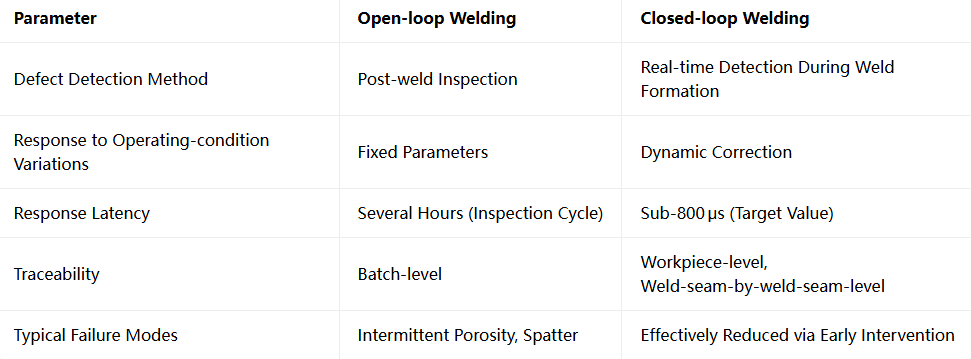
At present, most fiber laser welding systems on the production line follow this process: setting parameters→laser welding→pick up→Offline testing. This feedback cycle usually takes several hours, while the physical process that truly determines the welding quality occurs within milliseconds or even shorter time scales.
This mismatch in time scale is the core limitation of open-loop welding. The laser itself can respond at the microsecond level, but the system responsible for monitoring defects is unable to do so during welding " invisible"Any process information.
Why is there a quality ceiling in open-loop systems
The open-loop system uses the same fixed parameters for each workpiece——Power, speed, focal position, pulse waveform, without considering the continuous changes in actual operating conditions. In real production, the following variables are constantly fluctuating:
· Differences between workpieces ——Gap tolerance, surface oxidation degree, coating batch differences, and fixture repeat positioning accuracy all affect the energy coupling of the welding interface.
· Thermal accumulation effect ——The first product welded in a cold start state, welded to the fixture after several hours of hot dipping500Even if the input parameters are exactly the same, the actual physical process of a product is completely different.
· Small hole instability ——Steam pores formed during deep penetration welding process(keyhole)It collapses and regenerates thousands of times per second, and each collapse is a potential pore or splash event.
To cope with these changes, open-loop systems typically adopt a more conservative process window to ensure that they can still operate under worst-case conditions. But the cost is that under most normal operating conditions, the system actually runs in a suboptimal state.
Working principle of closed-loop laser welding
The three necessary conditions for a truly closed-loop system
A truly effective closed-loop laser welding control system requires the collaborative work of the following three elements:
one Testing( Detection ) ——Sensors must observe the molten pool status in real-time during the welding process, rather than relying on post weld detection.
two Delay( Latency ) ——The time from detection to execution of correction must be shorter than the evolution time of the defect event itself.
three Correction speed( Correction Speed ) ——Laser light sources must have fast enough power modulation capability to perform calibration actions.
Why Asia 800 microseconds delay is the industry benchmark
The evolution time of small hole collapse events is usually within zero point five ~2Between milliseconds. If the response time of the control system exceeds this window, the parameters of the next welding cycle can only be adjusted afterwards, and the defects that are occurring cannot be recovered.
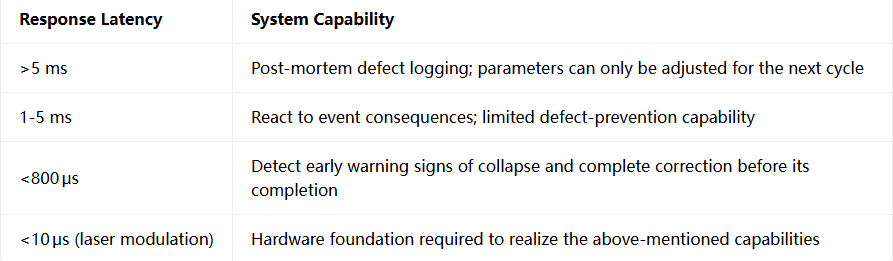
In Asia 800 At the microsecond delay level, the system can identify early signs such as hole depth change, plasma emission intensity change, and adjust the laser output before the collapse event completely occurs. This is exactly "Predictive correction"give" Passive
recording" The essential difference between them.
Sensing architecture for real-time welding quality monitoring
Accurately detecting the behavior of small holes and molten pools requires multiple complementary sensing channels to work together, as a single sensor cannot fully capture the
entire process state.
Optical coherence tomography imaging(OCT)
OCT Can provide direct measurement of sub micron pore depth. Due to its much smaller impact on plasma plume interference compared to conventional visible light imaging,OCTIt can directly read the depth of fusion data, rather than indirectly calculating based on parameters such as power and speed.
Multi wavelength photoelectric detection array
adopt UV (300~500nm)Visible light(700~900nm)Infrared(1000~1100nm)Three channel photodetector, to 100kHz The above sampling rates are synchronously collected, and each channel captures different process information:
·UV Channel: Plasma emission intensity
·Visible light channel: molten pool thermal radiation
·Infrared channel: backscattered and reflected signals in the laser action zone
Three channel synchronous acquisition provides stronger discriminative ability for control systems compared to single channel sensors.
high-speed CMOS camera
At a rate of per second 1 Wan Zhi10Running at a speed of 10000 frames per second, high-speed cameras can provide spatial information that point sensors cannot obtain——The geometric shape of the molten pool, the shape of the small hole outlet, and the specific location where splashing occurs. Combined with time-series sensing data, the system not only"Detected"Defects can also be accurately located.
Post weld forming camera
The post weld forming camera is used to measure the geometric shape of the weld surface, forming a closed loop between real-time process data and workpiece level acceptance standards.
Targeting sub millisecond level decision-makingAI processing architecture
with 100kHz The amount of sensor data collected at sampling rates and above far exceeds that of traditional methodsPIDThe processing capability of the controller within the required time window. Therefore, a layered approach is usually adoptedAIframework:
· CNN (Convolutional Neural Network) ——Process spatial anomalies in high-speed camera images, identify small hole instability patterns and melt pool geometric shape deviations.
· LSTM (Long Short Term Memory Network) ——analyzeOCTIdentify the precursor signals of collapse events before they occur based on the temporal patterns in the photoelectric detection data.
· Physical Information Neural Network( PINN ) ——Constrain the model output based on thermodynamic laws to reduce the risk of providing physically infeasible or potentially secondary defect correction recommendations.
In this processing chain, deterministic timing is equally important as computing power. Vibration in the control circuit( jitter )It will introduce delay fluctuations, and no matter how strong the individual model's ability is, it will weaken the sub model 800
The implementation effect of microsecond target.
Welding Traceability: Digital Archive Behind Each Weld Seam
Each welding event can generate a complete record with a timestamp, including OCT Penetration data, photoelectric detection signals of each channel, camera frame sequenceAIDecision logs and actual corrective actions executed, and associated with specific workpiece serial numbers.
For power battery assembly and aerospace manufacturing, workpiece level welding traceability is increasingly becoming a mandatory requirement for certification access, rather than an optional feature. Structured digital records make it feasible to trace the entire process at this mass production scale.
Key differences between open-loop and closed-loop laser welding
How to evaluate a closed-loop laser welding system
For the engineering team evaluating whether closed-loop control is needed for the production line, the following questions can help clarify the existing gaps:
· Is the welding area equipped with real-time sensors? What have been configured?
·End to end detection-What is the actual correction delay?
·Is the quality data traceable on a weld by weld basis or only at the batch level?
·Is there a correlation between intermittent porosity defects and fixture temperature, shift switching, or material batch fluctuations?
If defects such as pores are intermittent and related to operating conditions, it usually means that this is an inherent limitation of open-loop systems, which cannot be solved by parameter tuning alone——Because the rate of change of input variables is faster than the response speed of the control loop.
Frequently Asked Questions and Answers(FAQ)
1. What is closed-loop laser welding? Closed loop laser welding is a process control method: sensors monitor the welding process in real-time and automatically adjust the laser output for correction before instability phenomena such as small hole collapse lead to defects, rather than relying on post weld detection to detect problems.
2. Why is response delay so crucial for laser welding quality control? Small hole collapse is one of the main causes of porosity and splash defects, and its evolution time is usually withinzero point five~2Between milliseconds. If the detection of the control system-If the correction delay exceeds this window, defects can only be recorded and cannot be prevented. Delay below800At microseconds, the system can complete calibration during the collapse initiation phase.
3. What sensors are commonly used for real-time welding monitoring? Common sensors include optical coherence tomography for measuring the depth of small holes(OCT)A multi wavelength photoelectric detection array for capturing plasma and thermal radiation signals, as well as a high-speed camera for observing the geometric shape of the melt pool and locating splashes. Due to the inability of a single sensor to provide a complete process image, these sensors are usually used in combination.
4. Why is welding traceability so important for power batteries and aerospace applications? The traceability of workpiece level welding can correspond process data such as penetration depth and correction actions with specific workpiece serial numbers one by one, providing support for quality audit and certification access, which is increasingly becoming a mandatory requirement in the mass production of safety critical components.
Conclusion
Closed loop laser welding solves the core problem that open-loop systems cannot overcome solely through parameter tuning: detecting and correcting process instability while welding is still in the forming process. Through integration OCT Multi wavelength photodetection, high-speed imaging, and physical constraints AI Models and closed-loop systems are dedicated to detecting-Correction delay compression to 800 Below the microsecond boundary——This is exactly" Predictive correction"give"Passive recording"The watershed. For manufacturing companies evaluating power battery or aerospace welding quality systems, response delay, sensing coverage, and workpiece level traceability are the three key criteria for determining whether an architecture meets production level requirements.
- Follow us

 0
0