
Fiber lasers have won. Cost per watt has collapsed year after year, and lasers are no longer exotic tools for a handful of high-tech niches — they are becoming the default processing tool across cutting, welding, cleaning, additive and many more. The penetration curve is still steepening, not flattening.
But there is an uncomfortable truth our industry rarely says out loud:
Service is the Achilles' heel.
A laser is still a very sophisticated instrument. Thousands of precision optical, power-electronic and thermal components, engineered to tight tolerances, running around the clock in hot, dusty, electrically noisy factories. This is not a commodity box. It never was.
And yet, for years, most of the industry's design effort has gone into one thing: cost-down. Another euro per watt out. Another line item shaved off the BOM. Reliability and serviceability were afterthoughts — something to deal with after the warranty expires.
The customer, of course, pays for that later. Their math is brutally simple:
Downtime cost = failure frequency × recovery time.
Cost-down engineering tends to make the first term worse. And the second term is where the industry's blind spot really shows — especially outside the manufacturer's home region. When something fails on a laser installed in Europe or North America, recovery is too often measured not in hours but in weeks: diagnose, remove, ship across borders, clear customs, repair or swap, ship back, reinstall, realign. The laser literally has to go home — and the customer's production waits.
It's telling that an entire ecosystem of independent service and refurbishment companies has grown up around this gap. When third parties build a business on your after-sales pain, the market is sending you a message.
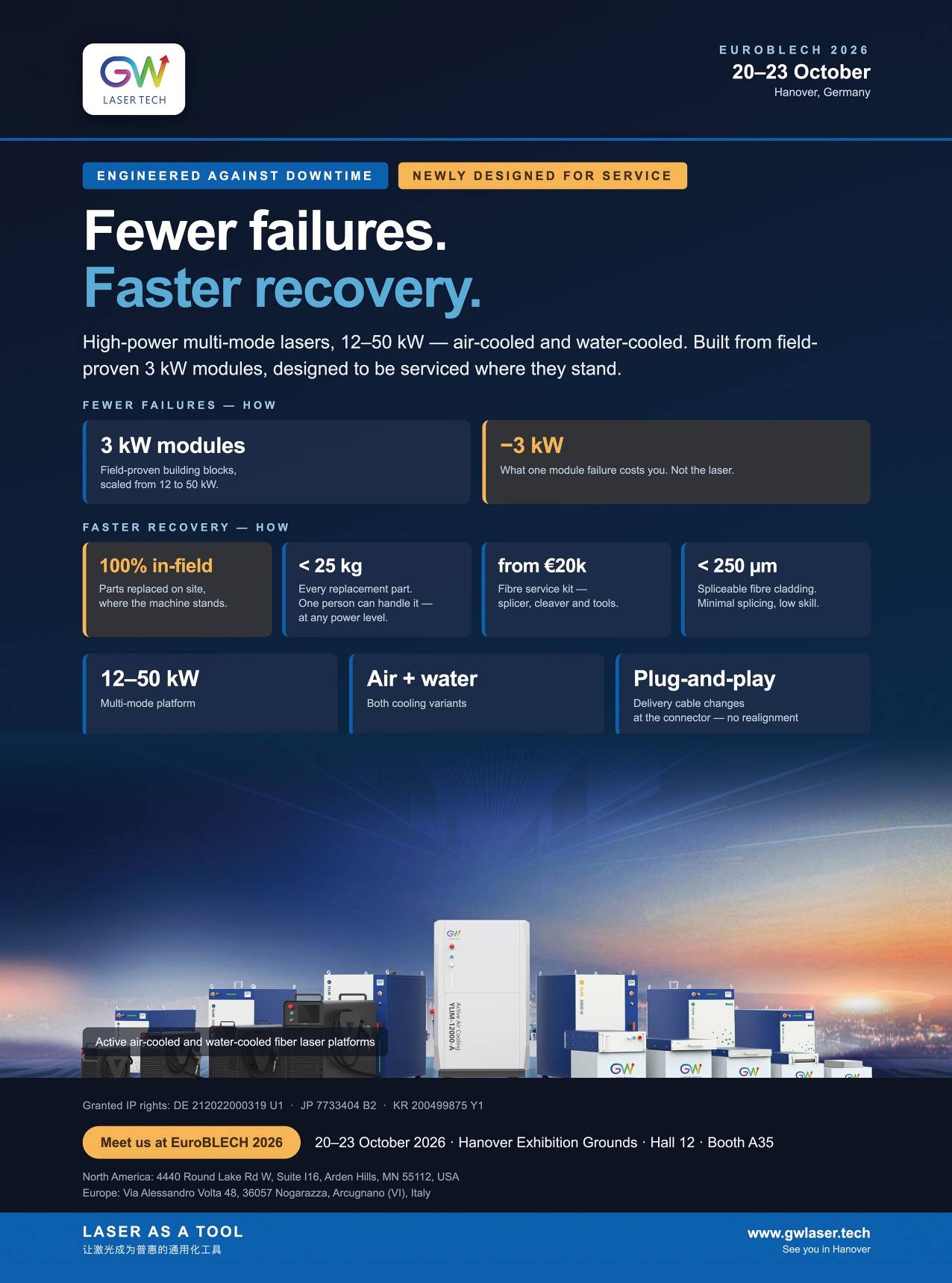
At GW LaserTech we decided to design against that message. Our new 12–50 kW multi-mode platform, showing at EuroBLECH 2026, was engineered against downtime — not engineered against a BOM:
- Built from field-proven 3 kW modules — fewer failure points, scaled from 12 to 50 kW
- 100% in-field replacement: every service part comes to the machine, not the other way around
- Every replacement part under 25 kg — one person, no crane, at any power level
- A complete fibre service kit (splicer, cleaver, tools) from €20k — not a six-figure spare-parts depot
- Splicable fibre cladding under 250 µm — minimal splicing, low skill, fast recovery
- Plug-and-play delivery cable changes at the connector — no realignment
Fewer failures. Faster recovery. Designed to be serviced where they stand.
Cost-down is not a strategy. It's a race to the bottom where the invoice arrives later, on the customer's floor, as downtime. The next decade of laser penetration will be decided not by who squeezes out the next €0.10 per watt, but by who keeps the world's lasers running.
If you're at EuroBLECH (20–23 October, Hanover), come see it at Hall 12, Booth A35. We genuinely welcome debate on this thesis with anyone who disagrees.
- Follow us

 0
0