
GW LASER | FRM TECHNOLOGY
In industries such as power batteries, liquid cooling plates and 3C electronics, aluminum alloy laser welding is virtually unavoidable — and yet it has long been the most frustrating station on the production line: weld porosity, violent spatter and blowouts, failed leak tests… rework rates stay stubbornly high, yields refuse to climb, and costs remain out of control.
GW Laser's FRM (Flow Regulation Mode) laser welding solution is fast becoming the mainstream way to break through these bottlenecks.
Four Bottlenecks of Aluminum Laser Welding
1. Highly reflective material — hard to keep stable
Aluminum reflects more than 90% of near-infrared laser light. With conventional single-mode laser welding, energy coupling is unstable — the process is prone to breakouts and large fluctuations.
2. Spatter & blowouts — contaminated workpieces
The molten pool erupts violently. Metal particles scratch the surface and contaminate the focusing optics — driving rework rates and consumable losses up at the same time.
3. Porosity & cracks — performance cut short
Hydrogen and entrapped shielding gas form pores and hot cracks in the weld pool, significantly reducing joint strength and service life.
4. Leak-test failures — sealing requirements not met
Pores that run through the seam cause helium leak tests and burst tests to fail. Sealed components — liquid cooling plates, battery housings and the like — are scrapped outright.
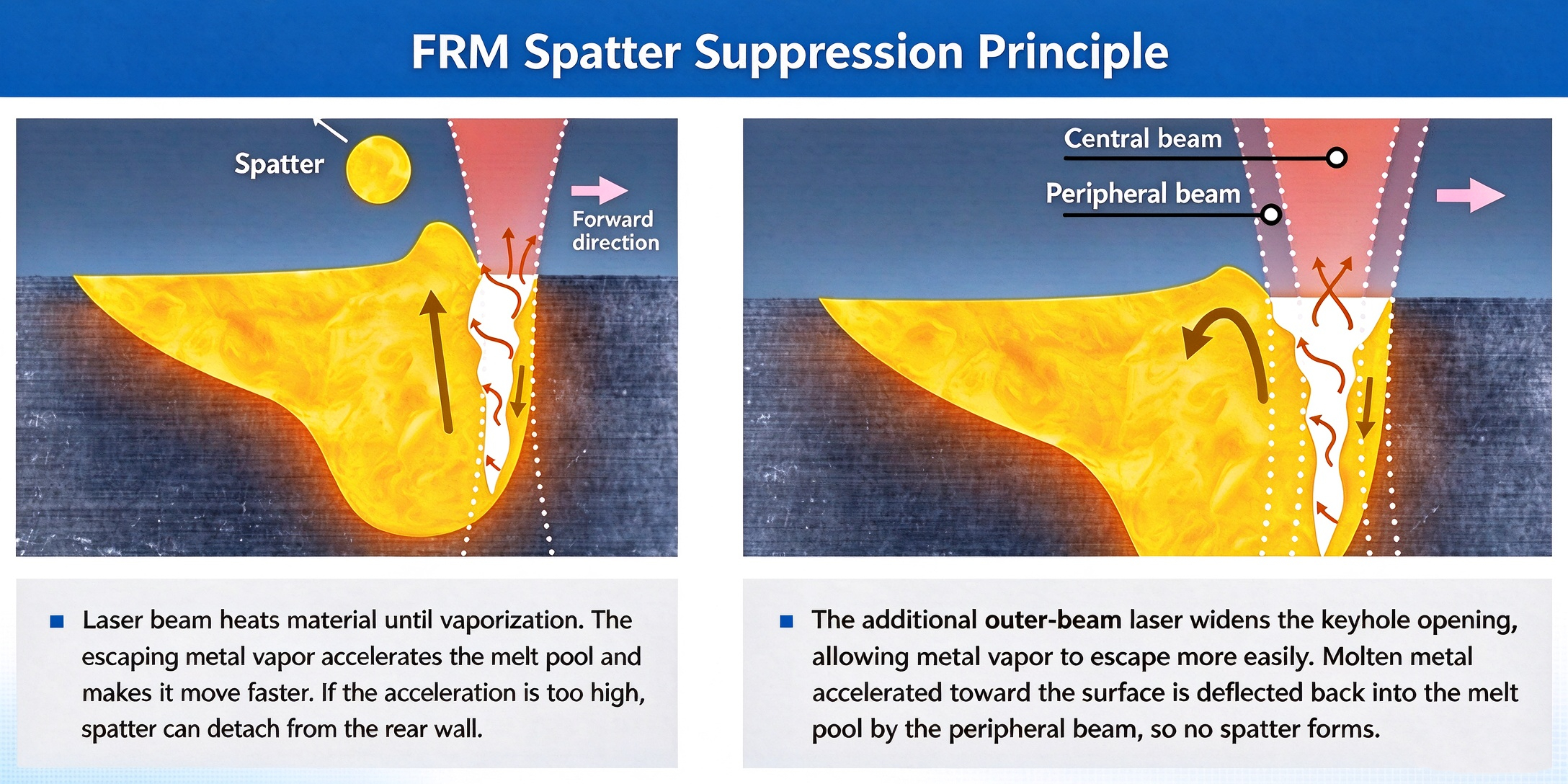
How FRM Works
At the heart of FRM (Flow Regulation Mode) is a single fiber that delivers two coaxial laser beams: a central beam dedicated to penetration depth and weld bead formation, and a peripheral beam that forms a “stabilizing ring” around the seam, responsible for preheating and weld-pool stabilization.
The power and firing sequence of the two beams can be adjusted independently in real time. The gentle temperature gradient created by the peripheral beam produces a “stirring-like” effect that suppresses violent molten-pool churning and stops spatter right at the source. A calmer weld pool also lets hydrogen bubbles escape more easily — and porosity drops naturally.
Three Core Advantages of FRM
① Low spatter
Measured data show that, compared with conventional single-mode welding, spatter is reduced by 60%–80% — optics contamination and post-processing costs fall dramatically.
② Fewer pores
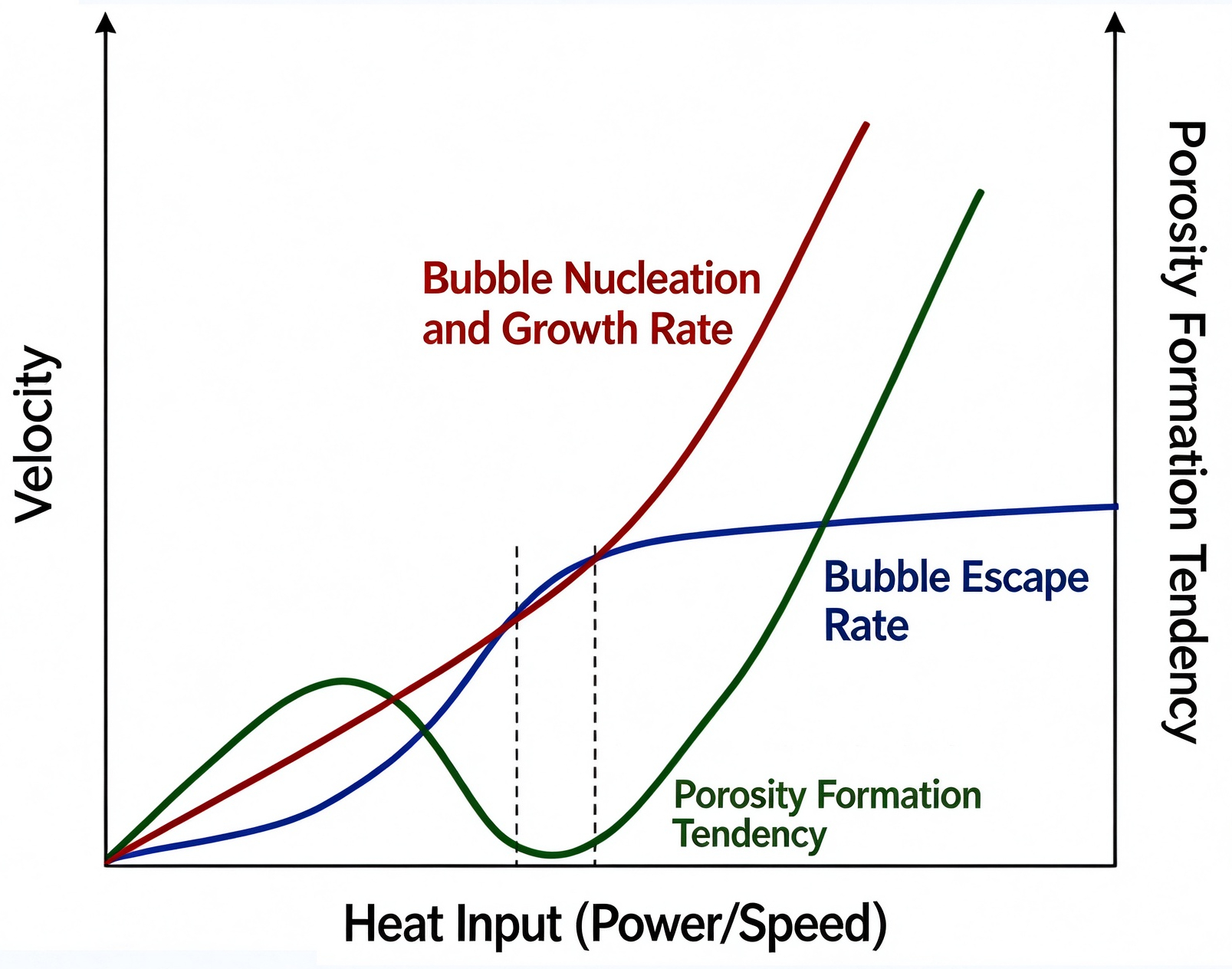
FRM suppresses keyhole porosity at the mechanism level. Combined with pretreatment and shielding gas optimization, aluminum alloy porosity can be held below 1%.
③ Excellent leak-tightness
With no through-thickness pores in the seam, helium leak tests pass on the first attempt. Burst tests on liquid cooling plates have reached the Grade 8 standard — no leakage in long-term service.
Porosity Control: The Progressive Three-Configuration Approach
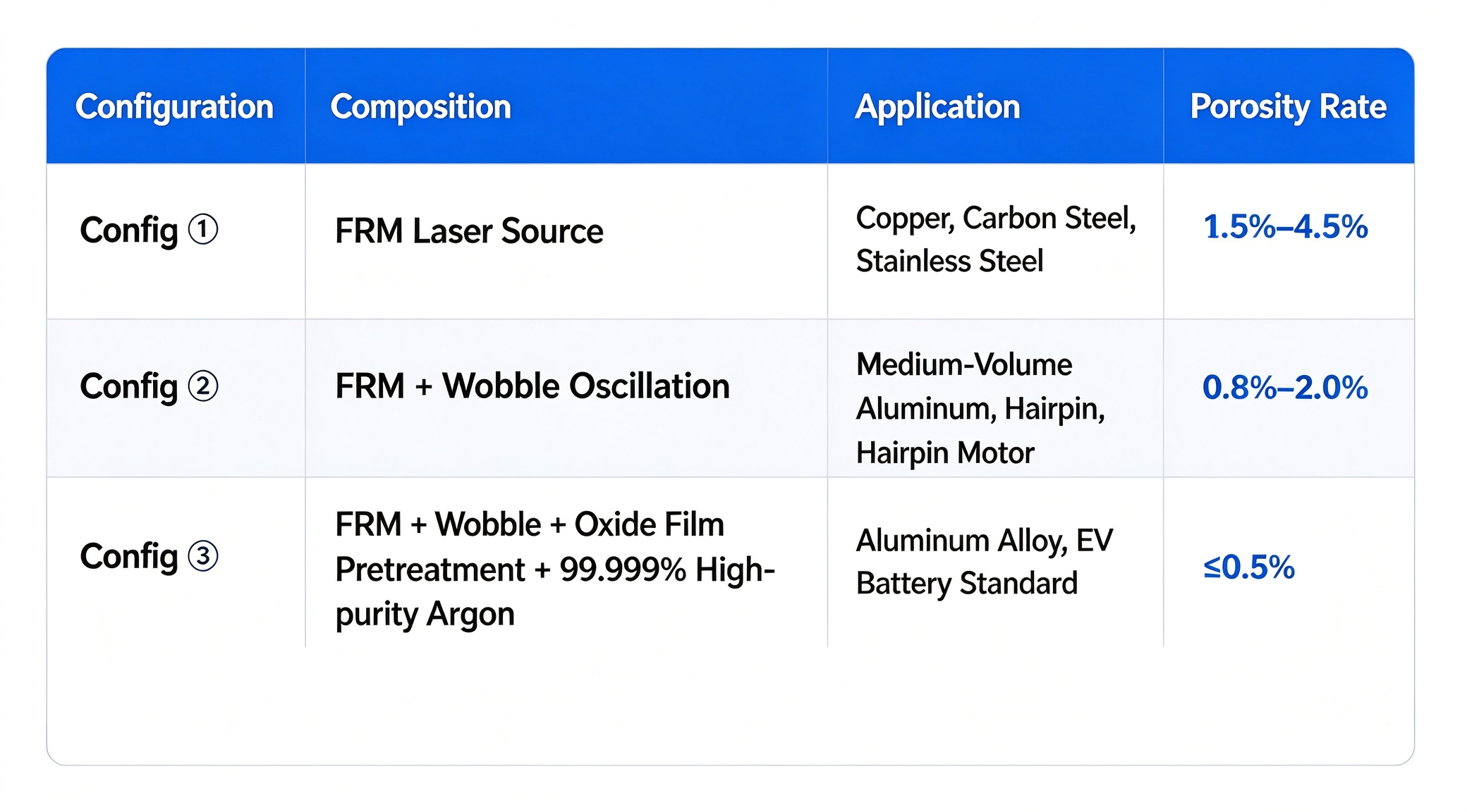
A special note: Porosity in aluminum alloys arises from two distinct mechanisms — keyhole porosity and hydrogen porosity. No laser alone can eliminate hydrogen porosity, which is why the industry standard is a progressive approach:
Aluminum alloy welding must use Configuration 3 — both porosity mechanisms must be addressed together; neither can be left out. This is also a key benchmark for judging whether a supplier is truly professional: any claim that “a single laser eliminates all porosity” deserves scrutiny.
A Wider Process Window, Higher Mass-Production Yield
FRM delivers more than better porosity numbers — it widens the entire process window:
The wider the process window, the higher the yield and the lower the overall cost — even ordinary operators can run stable production. For scaled-up production lines, that makes all the difference.
Typical Applications
FRM (Flow Regulation Mode) has already been deployed at scale across four fields:
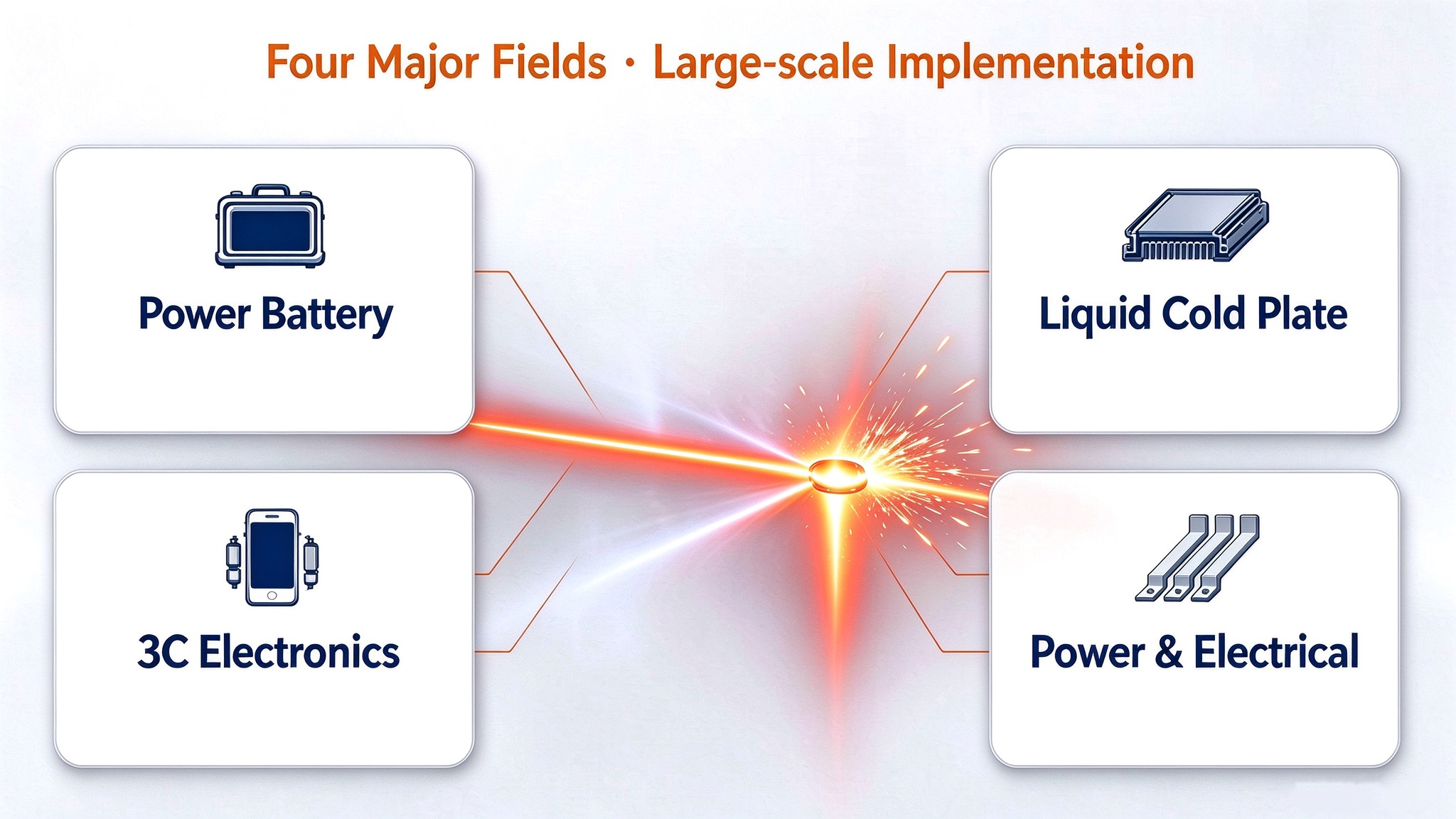
Power batteries — top covers, sealing pins, bus bars, terminals (posts)
Liquid cooling plates — defect-free micro-channel overlap welding, zero helium leak
3C electronics — precision aluminum parts with excellent appearance, no post-processing
Power & electrical — busbars and heat sinks with batch-to-batch stability
The difficulty of aluminum welding has never been “can it be joined?” — it is “can it be joined well, repeatably?” When selecting a solution, keep three keywords in mind:
Molten pool flow controlClear porosity mechanismsComplete configuration
GW Laser is committed to turning precision beam control intoa reproducible, mass-producible aluminum welding capability — delivering every aluminum weld with low spatter, minimal porosity and reliable leak-tightness. Together with industry partners, we are moving aluminum welding from “experience-dependent” to “process-controlled”.
- Follow us

 0