
In the copper welding scenarios of industries such as new energy lithium batteries, copper busbars, and precision electrical components, 6kW point ring composite spot fiber laser It has already become a mainstream choice. Compared to traditional single-mode spot welding, point ring spot welding relies on the structural advantage of "central pinhole breakdown+outer ring melt pool control", perfectly solving industry problems such as high reflection, easy splashing, unstable pinhole, and poor forming in copper welding, and becoming the preferred equipment for high reflection material welding.
However, in the actual selection process, the vast majority of end customers and integrators will fall into a common misconception: Under the same total power of 6kW, the higher the power of the laser center spot, the stronger the welding performance. Therefore, many people default to models with a "34 μ m center 4000W" configuration, which is superior to configurations with a 20 μ m center 3000W and a 14 μ m center 2000W.
[Core Conclusion] The large-scale sample testing and mass production landing case of GW Laser proves that welding high reactive materials such as copper is never about the absolute power of the center, but rather Power density of core spot The three mainstream 6kW point ring lasers each have their own adaptation scenarios, and for the most difficult copper welding, it seems that the one with the lowest center power is 14 μ m+100 μ m (2000W center+4000W outer ring) The model is the true optimal solution for high reflectivity welding.
01 First, clarify the industry mainstream: three 6kW point ring spot power configurations
At present, there are three standardized configurations for 6kW point ring composite spot lasers on the market, with a total power of 6000W. However, the power distribution and core diameter size of the center and outer rings are completely different, accurately corresponding to different processing scenarios:
① 14 μ m center+100 μ m outer ring (2000W+4000W)
GW Laser specializes in high reflectivity materials, with a small core diameter and high peak center, paired with a high-power outer ring, focusing on high breakdown and stable melt pool.
② 20 μ m center+120 μ m outer ring (3000W+3000W)
Industry standard balanced configuration, with equal power distribution between the center and outer rings, balancing breakdown capability and melt pool filling, suitable for the vast majority of conventional metal welding.
③ 34 μ m center+100 μ m outer ring (4000W+2000W)
Large center power configuration, focusing on the total energy output of the center, weakening the power of the outer ring, and emphasizing wide melt path and large filling welding.
From the surface parameters, many customers will directly judge the advantages and disadvantages: 4000W center power>3000W>2000W, naturally assuming that the 34 μ m large center model has the best copper welding effect. But this judgment logic completely ignores the copper welding process Core physical characteristics This is also the essential difference between high reactive material welding and ordinary carbon steel and stainless steel welding.
02 Core Science: Why can't we just look at the "center power" when welding copper?
Copper is a typical ultra-high reflectivity material in the industrial field. In the 1064nm wavelength range commonly used in fiber lasers, the laser reflectivity can reach up to at room temperature Over 95% This means that the vast majority of incident laser light will be directly reflected by the surface of the copper material and cannot be effectively coupled into the interior of the material.
Ordinary low reactive materials (carbon steel, stainless steel) welding can be completed as long as the laser power is sufficient and the energy supply is sufficient. But the core difficulty of copper welding is only one: Breakthrough the high reflection barrier on the surface and quickly establish stable welding holes.
To break through the surface of copper and form a sustained and stable keyhole effect, it does not rely on the "total energy", but on Instantaneous peak power density ——That is, the energy concentration within a unit spot area. The larger the core diameter of the light spot, the more dispersed the energy; Even if the total power is significantly increased, the energy density will be greatly diluted, and the breakdown capability will decrease instead of increasing.
Power density=Spot power ÷ Spot area
Power is the total amount, density is the concentration——
High anti material breakdown, only recognizing concentration.
03 Hardcore data calculation: 2000W small core diameter, density far exceeds 4000W large core diameter
We offer three models Central core welding area As the only measurement standard (the outer ring is mainly responsible for melt pool regulation, splash suppression, and stable forming, and does not directly participate in high reflectivity surface breakdown during the initial breakdown and hole building stage), the difference in real power density is compared through precise calculation:
14 μ m core diameter+2000W centerApproximately 12.99 W/μ m ²
20 μ m core diameter+3000W centerApproximately 9.55 W/μ m ²
34 μ m core diameter+4000W centerApproximately 4.41 W/μ m ²
The data is enough to overturn traditional knowledge: the center power density of the GW Laser 14+100 configuration is higher than that of the 34 μ m 4000W large center model 195% , higher than the 20 μ m balanced model 36% 。
Even though the central power is only 2000W, which is less than half of the 34 μ m model, the extremely small light spot allows energy to be highly concentrated, forming a strong instantaneous breakdown capability.On the other hand, the 34 μ m large center 4000W model appears to have doubled power, but the spot area has significantly increased, the energy has been noticeably diluted, and the peak penetration power has weakened. It does not have an advantage in breaking through the high reflection barrier of copper.
In the actual welding process, the 34 μ m large center model is more prone to phenomena such as strong laser reflection, decreased stability of small holes, increased welding spatter, increased porosity in the weld seam, and fluctuations in penetration depth. This is also one of the reasons why some customers encounter bottlenecks in improving yield when using high-power center lasers to weld copper.
04 Optimal Copper Welding Combination: Dual Advantages of High Density Peaks and High Power Outer Ring
The 6kW point ring configuration of GW Laser with 14 μ m+100 μ m has become the golden solution for copper welding due to its ultimate division of labor, bidirectional complementarity, and perfect adaptation to the welding process requirements of high reactive materials. It is also the optimal carrier for FRM melt pool flow control technology.
1. Small core diameter high-density center: specializing in high impact penetration
The ultra-high power density brought by the 14 μ m ultrafine center spot can instantly penetrate the high reflective surface of copper in milliseconds, quickly establish a stable keyhole, reduce laser reflection loss from the root, avoid small hole collapse, and solve the core pain point of "difficult to arc and unstable" copper welding, making the welding process continuous, uniform, and without broken holes.
2. Ultra high power outer ring: stable melt pool, splash suppression, optimal molding
Unlike the conventional configuration in the industry, this model has an outer ring power of up to 4000W, and sufficient outer ring energy can fully wrap and regulate the welding pool. After completing the penetration and hole construction in the center, the high-power outer ring can stabilize the flow of the molten pool, suppress the splashing of copper liquid, fill the gaps of the weld seam, optimize the flatness of the weld seam, and effectively solve common problems such as large splashing, weld collapse, and rough forming in copper welding.
The configuration of 2000+4000W places more power in the outer ring, but it is precisely the higher power density in the center that makes it easier to open and maintain the keyhole; After the copper material is heated during the welding process, the absorption rate of laser energy by the liquid molten pool will significantly increase. At this time, the high-power outer ring can not only stabilize the molten pool, but also contribute considerable deep melting ability, achieving the dual benefits of "stable forming" and "increased melting depth".
The center is responsible for 'being able to penetrate and maintain stability'Outer ring is responsible for "welding flat and of high quality"
The outer ring power of the 34 μ m large center model is 2000W. While the peak density is relatively low, the margin for controlling the melt pool is also relatively limited. When facing high reactive materials such as copper, it is relatively difficult to guarantee the stability of the melt pool and the yield of finished products. The 20 μ m balanced model has balanced parameters and no obvious shortcomings, but in high-end copper welding scenarios with ultra-high precision and high stability, the characteristic of relatively insufficient peak density will gradually emerge.
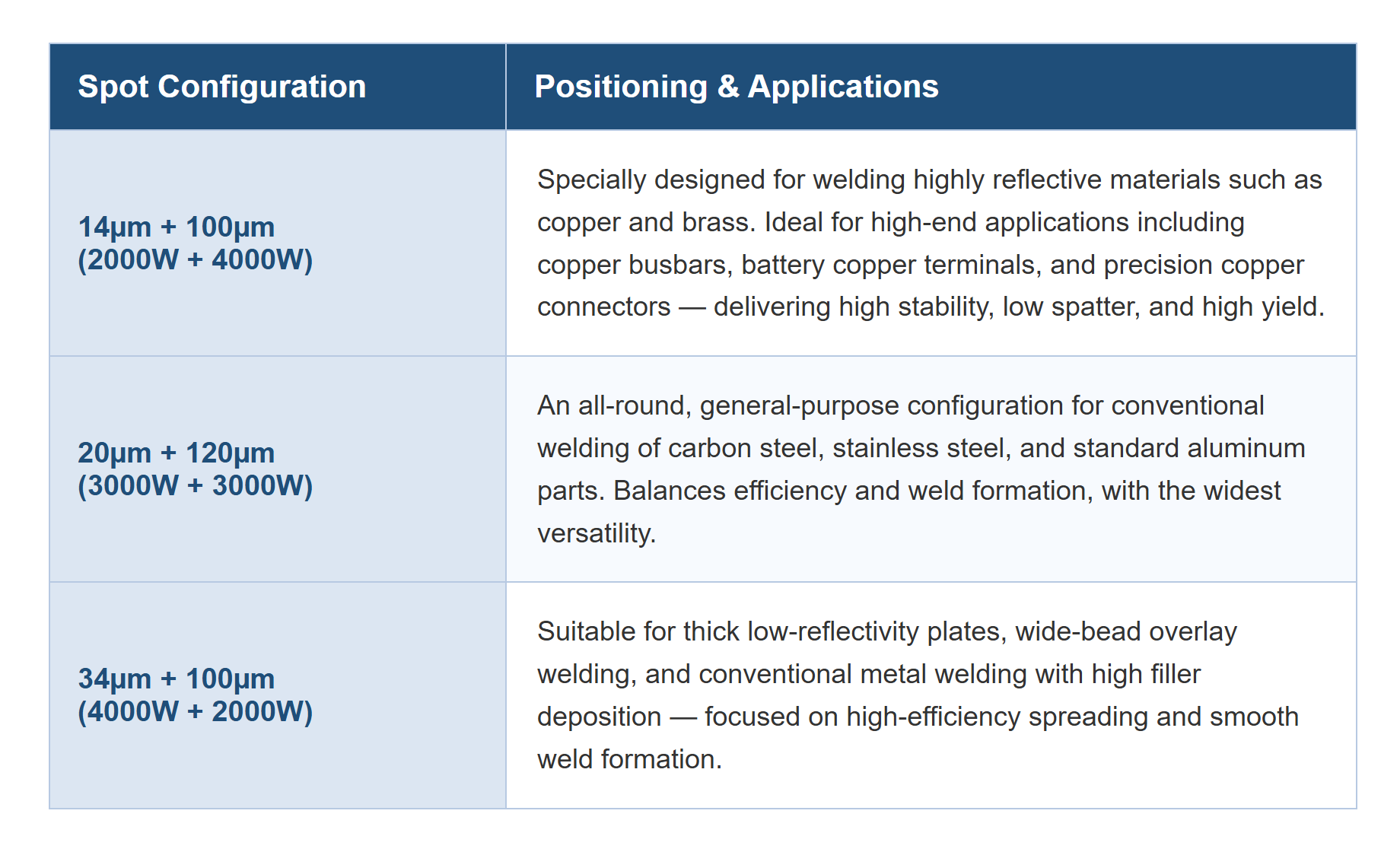
05Accurate scene differentiation: Three 6kW point ring lasers each have their own strengths
We are not denying the value of the 34 μ m and 20 μ m configurations. The three models only have different scene adaptations, and there is no absolute superiority or inferiority. The only difference is whether they are adapted or not:
Summary: Choose copper laser welding and reject the "power only theory"
In the field of welding high reactive materials such as copper, absolute power has never been the standard for evaluating equipment performance, Peak power density and spot structure ratio This is the core key.
At a power level of 6kW, our exclusive configuration of a 14 μ m ultra-fine high-density center and a 4000W high-power outer ring breaks the selection misconception of "the higher the power, the better". With industry-leading center energy concentration, we perfectly solve the core problem of high reactive material welding.
From new energy precision copper components to industrial electrical copper welding, this golden spot configuration, with stable breakdown capability, excellent melt pool control effect, and extremely low splash defects, has become the core guarantee for high yield and high efficiency in mass production conditions, providing the optimal technical solution for high reactive material laser welding.
Remember one sentence: Welding copper depends on density, not absolute power; The 14 μ m high-density center is responsible for breakdown, and the 4000W outer ring is responsible for forming - high reverse welding. Choosing the right spot ratio is the key.
- Follow us

 0